November 2021

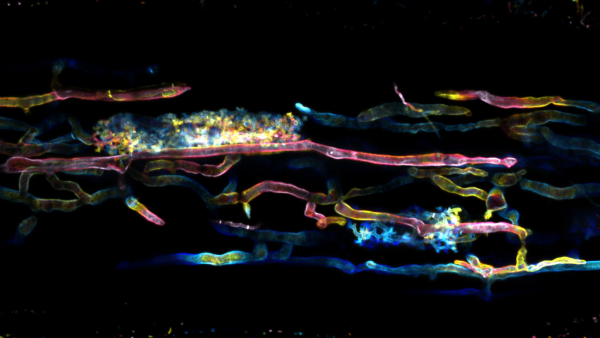
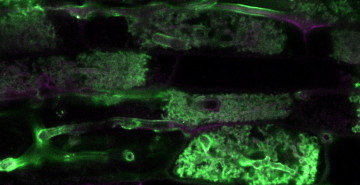
Alexandra Dallaire of the Gurdon Institute and Crop Science Centre researcher Uta Paszkowski are authors on recent research proposing that well controlled ‘jumping’ of DNA sequences within the genome might contribute to AM fungi genomic evolution. The research supports a model in which these ‘jumping’ genes, also referred to as transposable elements, shape the genome of AM fungi, while DNA methylation and small RNA–mediated silencing keep their overproliferation in check.
AM fungi have long been considered as ancient asexuals. Long-term clonal evolution would be remarkable for a eukaryotic lineage and suggests the importance of alternative mechanisms to promote genetic variability facilitating adaptation in these at least 450 million years old organisms.
View the paper: https://genome.cshlp.org/content/early/2021/11/12/gr.275752.121.abstract
News
July 2026
New film captures mycorrhiza in motion for the first time

News
June 2026
Rethinking plant photoprotection: new insights into antenna protein CP26

News
June 2026
Uta Paszkowski recognised as a 2026 Top Agri-food Pioneer by the World Food Prize Foundation

News
June 2026
Rice research reveals the hidden control levels in plant-fungal partnerships

News
June 2026
Uta Paszkowski appointed Director of the Crop Science Centre and Russell R. Geiger Professor of Crop Science

News
May 2026
Cambridge plant scientists elected as Fellows of the Royal Society 2026

News
May 2026
Cambridge Plant Sciences hosts ASPIRE-GreenTE network event

News
May 2026
Naturally occurring soil fungi could boost rice yields while reducing reliance on synthetic fertilisers

News
May 2026
Can we feed the world without breaking the planet?

News
April 2026
NAS honours Professor Uta Paszkowski at official signing ceremony

News
March 2026
Hacking for hunger: global scientists gather in Accra to code climate-resilient crops

News
March 2026
CEO Professor Mario Caccamo leaving Niab