Field trials in India show that bio-fertilisers containing naturally occurring soil fungi enhance growth in rice plants. This may offer a pathway to reducing farmers’ reliance on synthetic fertilisers, and reducing greenhouse gas emissions in rice farming.
The trials, led by researchers at the University of Cambridge’s Crop Science Centre (CSC) in partnership UK rice brand Tilda and basmati farmers in India, tested fungi-based bio-fertilisers under real farming conditions.
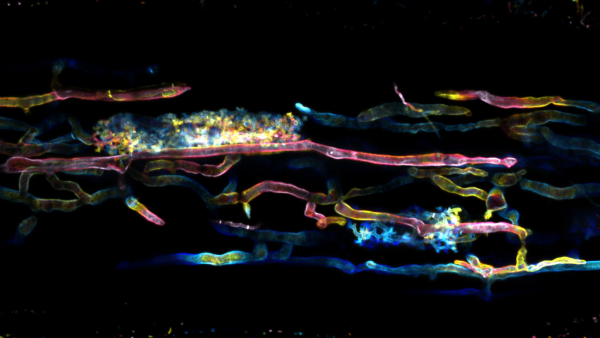
These bio fertilisers contain arbuscular mycorrhizal fungi – beneficial soil fungi that can live inside plant roots and help to extend their reach into the soil to collect nutrients.
In a report released today by Tilda, trial results show a yield boost of between 5% and 15% in basmati rice grown using synthetic and bio-fertilisers together, compared with rice grown using synthetic fertilisers alone.
“Every farmer in the trial saw increased rice yield in fields where they applied mycorrhiza-based bio-fertilisers, compared to the fields without it,” said Dr Emily Servanté, a researcher in the Cereal Symbiosis group at CSC and lead scientist on the trial.
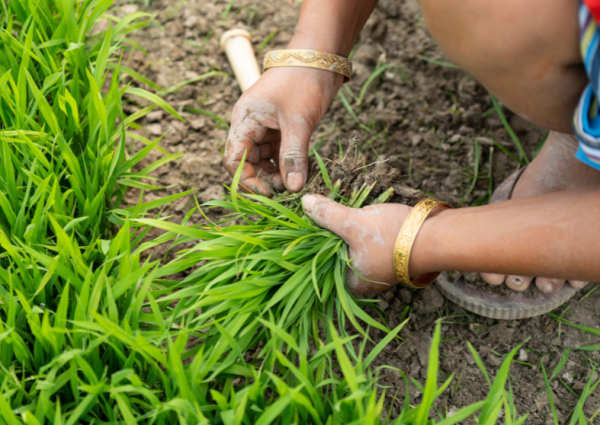
The trials took place on rice farms across northern India that use a water-saving irrigation technique called ‘Alternate Wetting and Drying’, developed by the International Rice Research Institute. Rather than the traditional practice of continuously flooded paddy fields, the fields are allowed to dry intermittently before being re-flooded – with farmers using a simple tube inserted into the soil to determine when re-flooding is needed.
Arbuscular mycorrhizal fungi thrive in the drier, more aerated soils that are becoming a key component of more sustainable rice production systems.
“These early-stage results are extremely encouraging. We’ve confirmed that arbuscular mycorrhizal fungi naturally associate with basmati rice plants, and that the bio-fertilisers enhance root development and crop vigour,” said Servanté.
She added: “The next step is to understand how this can translate into reduced fertiliser use and lower emissions at scale, while ensuring that any solutions remain practical and sustainable for farmers.”
With more than 4,000 farmers in Tilda’s network, tests will now be scaled up to assess the effects of reduced synthetic fertiliser on basmati rice yields.
Growing rice using synthetic fertilisers leads to emissions of nitrous oxide, a potent greenhouse gas, which contributes 12% of all agricultural emissions. Reducing the amount of synthetic fertiliser used in farming will also benefit soil health by enabling an increased microbial diversity in the soil.
“I’m excited that the farmers are on board, that everyone’s excited to work together to figure out how to roll this technology out in the best way. We’ve got all the right people in the right place at the right time,” said Servanté.
Reducing water use to reduce emissions
Waterlogged rice paddies emit huge amounts of methane, a potent greenhouse gas. Other work by Tilda has found that the adoption of the ‘Alternate Wetting and Drying’ (AWD) practice reduces methane emissions by about 45%. Reduced irrigation water use also cuts energy-related emissions by about 25%.
However, the periodic dry soil conditions in AWD can stimulate soil microbial processes that release nitrous oxide, another potent greenhouse gas, potentially offsetting up to 10-15% of the methane emission savings from AWD use. Servanté’s research offers a potential solution.
Tilda is the first UK rice company to be B Corp certified and seeks to be one of the most responsible rice producers in the world. There are now 3,840 farms in Tilda’s basmati sustainability rice-growing programme, delivering significant reductions in water use and greenhouse gas emissions across the supply network.
A critical moment for fertiliser use
The potential to reduce synthetic fertiliser use is particularly significant in today’s global context. Fertilisers are essential to modern agriculture, but their production is energy-intensive and heavily dependent on natural gas. Recent global disruptions – from geopolitical tensions to energy price volatility – have exposed vulnerabilities in fertiliser supply chains, leading to price spikes and reduced availability for farmers in many regions.
“Against this backdrop, improving nutrient use efficiency is not just an environmental priority, but an economic and food security imperative,” said Tilda MD Jean-Philippe Laborde.
He added: “By enhancing natural soil processes through bio-fertiliser use, our partnership with Dr Servanté and the University of Cambridge Crop Science Centre could help farmers reduce input dependency, lower costs, and build resilience against future supply shocks.
“This represents a powerful alignment of sustainability and practicality, whilst helping to future-proof basmati rice production in an increasingly uncertain world.”
Adapted from an article by Jacqueline Garget published on the University of Cambridge research news pages on 20 May 2026. Read the original article.
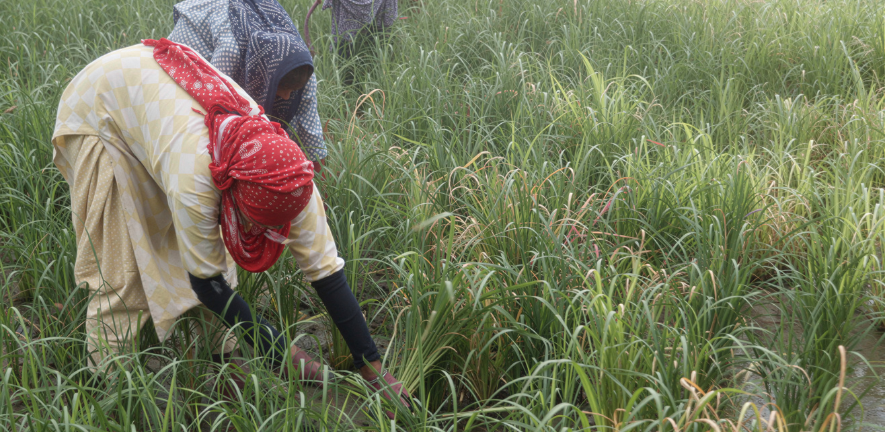
Women farmers in a rice field in India. Credit: Studio Charuau.