A recent review from the Crop Science Centre discusses the establishment of arbuscular mycorrhizal (AM) symbiosis from the perspective of the rice receptor DWARF14-LIKE (D14L).
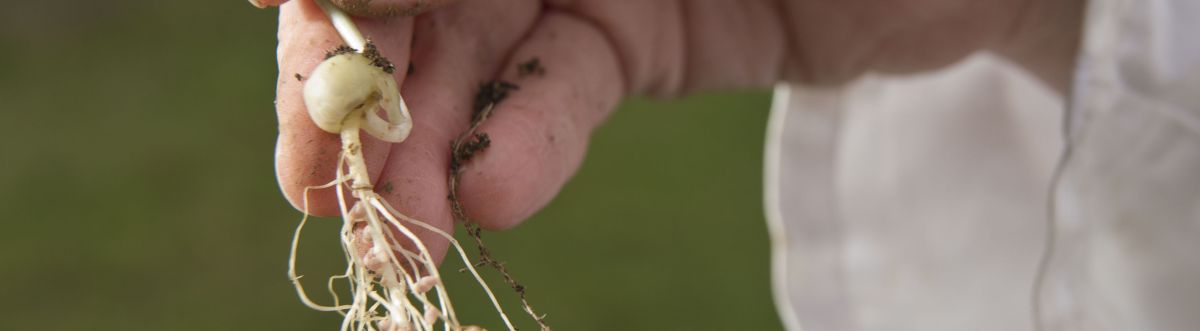
Published in July of 2021 in the journal Current Opinion in Plant Biology as part of a themed issue on biotic interactions, the review proposes that D14L signalling modulates the physiological condition of the plant to create a permissive state for AM symbiosis, underpinning attraction and enabling accommodation of the symbiotic fungus.
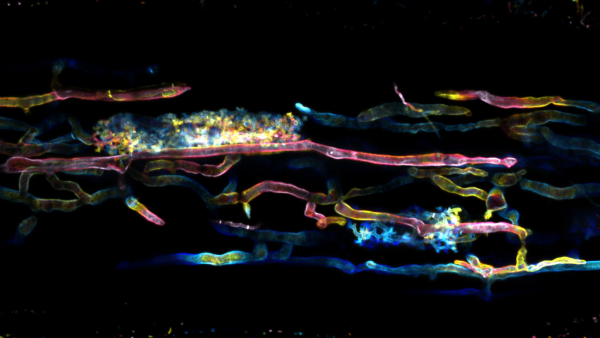
AM symbiosis is a plant-fungal mutualism that arose approximately 450 million years ago in early land plants. In this relationship plants can derive up to 100% of their phosphorus needs and around 40% of their nitrogen needs from AM fungi. In fact, it is thought that AM symbiosis is the default plant nutrient uptake strategy and so is central to plant performance and ecosystem productivity.
Raphaella Hull, plant scientist at the Crop Science Centre, said “The receptor D14L is essential for the perception of AM fungi by rice plants. In this work, we discuss how D14L integrates hormonal signals to prepare plants for AM symbiosis. We highlight research showing that D14L regulates the biosynthesis and exudation of the plant hormone strigolactone, the best known and potent attractant for AM fungi, via degradation of the repressor SMAX1. In addition, we draw attention to data that suggests that D14L signalling also has a role in regulating the biosynthesis of gibberellic acid. Altogether, our current understanding of D14L signalling leads us to propose that D14L is a central regulator of symbiotic competency, whilst further research is required to elucidate the downstream signalling pathway of SMAX1 and the evolutionary conservation of D14L function.”
Click here to read the review paper.