Research from the Cereal Symbiosis group shows how rising carbon dioxide (CO₂) levels affect nutrient uptake in rice and highlights the importance of beneficial soil fungi as a vital ally for sustaining crop yields and carbon storage in a changing climate.
As atmospheric carbon dioxide (CO₂) levels continue to climb, researchers are working to understand how our most essential crops will adapt to the changing climate. While higher CO₂ can boost photosynthesis and growth in cereals like rice, these gains are often limited by the availability of essential nutrients, particularly phosphorus.
A new study from the Department of Plant Sciences, published in the Proceedings of the National Academy of Sciences (PNAS), has revealed how rice plants reprogramme their nutrient acquisition strategies in response to elevated CO₂. The research, led by the Cereal Symbiosis group at Cambridge in collaboration with colleagues from the University of Copenhagen, highlights a fundamental shift in how rice interacts with beneficial soil fungi to secure its future.
The power of partnership
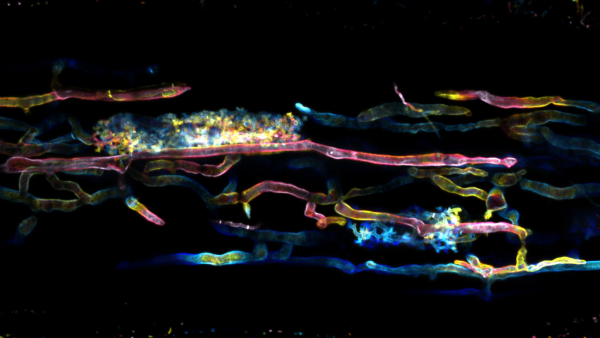
Most land plants, including cereals like rice, typically have two ways to get phosphorus: they can forage directly through their roots or form a partnership with arbuscular mycorrhizal (AM) fungi. In this carbon-for-phosphate trade, the plant supplies the fungus with carbon in the form of sugars and lipids, while the fungal hyphae extend far into the soil, acting as a second root system that scavenges phosphate from beyond the reach of the plant’s root.
The study found that under elevated CO₂ (900 ppm), rice plants significantly increased their reliance on this fungal partnership. Interestingly, this wasn’t because the plants were signalling more strongly to attract soil fungi, but because the extra carbon available from increased photosynthesis effectively fuelled more fungal growth and more efficient nutrient exchange.
PT11 – a genetic checkpoint
The researchers identified a specific phosphate transporter, PT11, as the checkpoint controlling this response. By using a rice mutant lacking this transporter, the team demonstrated that PT11 acts as a local gatekeeper. When PT11 successfully imports phosphorus from the fungus, it triggers a cascade of changes suppressing the plant’s own direct uptake pathway and remodelling the root system.
“Our findings show that elevated CO₂ reinforces symbiotic uptake through PT11, which then coordinates the entire root’s nutritional strategy,” Professor Uta Paszkowski, Head of the Cereal Symbiosis group and co-author of the paper said. “This includes a notable reduction in fine lateral roots – the parts of the root system usually used for direct foraging – as the plant shifts its investment towards the fungal partner.”
Transcriptional waves
Beyond physical changes, the study used advanced transcriptomic profiling to reveal that the symbiosis proceeds in waves. The first wave involves early signalling to accommodate the fungus, while a second, PT11-dependent wave is required to fully activate the plant’s metabolic and nutrient-exchange programmes.
Under high CO₂, this second wave becomes even more pronounced, shutting down competing nutrient pathways and even altering the plant’s internal defence chemistry. This suggests that in a high-CO₂ world, the symbiotic state could be a primary driver of how crops like rice manage their resources.
Dr Chai Hao Chiu, Postdoctoral Research Associate in the Cereal Symbiosis group and lead author of the paper, explained: “Elevated CO₂ makes the exchange between rice and its symbiotic fungi more productive. Because phosphate import through PT11 is what drives the symbiotic programme forward, the plant commits to the fungal route rather than just topping up its own. If that holds true in the field, breeding for symbiotic performance becomes as important as breeding for direct uptake.”
Securing future harvests
Understanding these mechanisms is vital for developing future-proof crops. By identifying the specific genetic pathways that govern how rice integrates carbon supply with nutrient demand, researchers can better predict how different varieties will perform as the atmosphere changes.
The work provides a mechanistic framework for integrating plant–microbe interactions into global strategies for sustainable food production and carbon management. As the planet warms, the silent partnership beneath the soil may prove to be one of our most important allies in maintaining global food security.
The power of international collaboration
The findings highlight not only a vital biological partnership beneath the soil, but also the immense value of cross-border academic teamwork.
“This study exemplifies how research projects can develop to generate unforeseen discoveries”, said Iver Jakobsen, Professor Emeritus at the University of Copenhagen, initiator of the study and co-author of the paper. “Our original goal was to understand why mycorrhizal symbiosis sometimes slows down plant growth. We are now excited that our experimental design – combined with the excellence of our colleagues at Cambridge University – demonstrates how mycorrhiza may be increasingly important to plant nutrient uptake under future climate conditions”.
Professor Paszkowski said: “This research illustrates the power of partnerships – not only in plant-fungal symbiosis but also in academic collaboration. It has been a joy working on this project which would not have been possible without the collaboration and complementary expertise of colleagues from Copenhagen as well as here at Cambridge.”
Reference: Chai Hao Chiu et al. ‘Elevated CO2 reinforces PT11-dependent symbiotic phosphate uptake to reprogram root nutrient acquisition in rice.’ PNAS, DOI: 10.1073/pnas.2606406123.
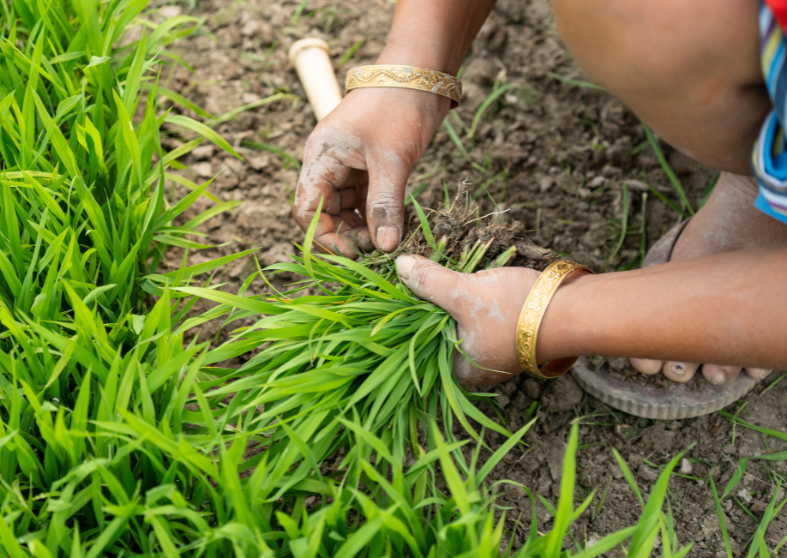
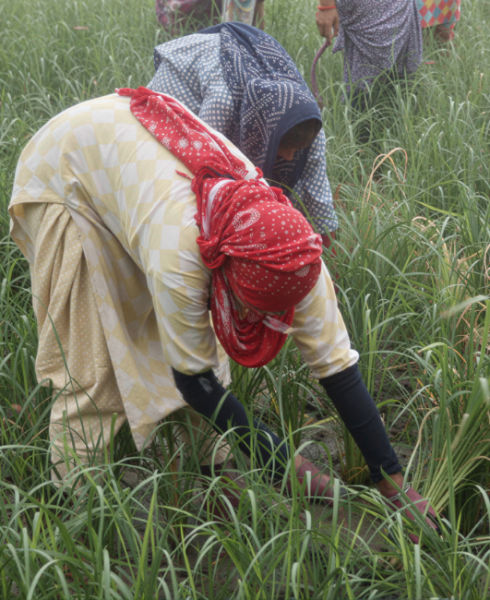
Image: Indian farmer picking rice saplings in the field. Credit: David Talukdar / Getty Images.